The basic matrix representations of rotations about the three fixed axes of an orthonormal coordinate system are easy to derive.
For right-handed rotation of an angle a, and column vectors, we get the following:
Around x, Around y, Around z
| 1 0 0 | | c 0 s | | c -s 0 |
| 0 c -s | | 0 1 0 | | s c 0 |
| 0 s c | | -s 0 c | | 0 0 1 |
Where c = cosine(a), s = sin(a).
Note:
An easy way to derive these matrices without having to go back to
pictures is use 'c' for the direction cosine of a component along it's
direction, and 's' or '-s' along the remaining direction depending on
the order of the components in the string x,y,z,x,y,z.
So per example, x on y gives 's' (since we have x,y in the string) while y on x gives '-s' (since we have z in between: y,z,x).
Using column vectors, matrix multiplication (as defined using linear map composition) is from right to left, so to rotate
around fixed axis
z (matrix
Rz) and then around fixed axis
x (matrix
Rx), we write the multiplication to get the total rotation matrix
R this way:
R = Rx * Rz.
Euler angles do not operate on
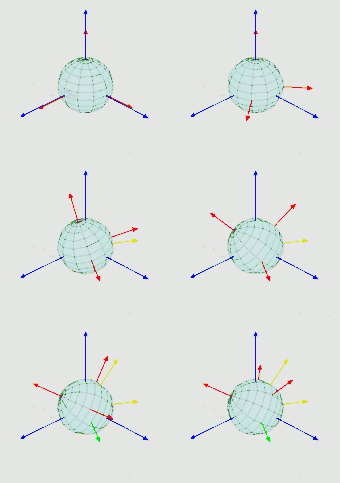
fixed axes, but on moving ones, as shown in the animation. So we cannot use the fixed axes
matrices, at least not directly.
The solution is to reverse the order. This means to perform an Euler angle rotation around
z and then (moving axis)
x
we use:
R = Rz * Rx.
But why does this work out? Here is a proof using basic linear algebra.
Proof:
To perform an Euler angle rotation around
z and then (moving axis)
x' the matrix composition goes this way:
R = Rx' * Rz, where
x' is the moving axis, obtained by rotating
x
by
Rz.
We call the basis (or frame) obtained by rotating
the standard basis
E3 by
Rz the basis
F'. Using a change of basis, we
notice that in the basis
F', the rotation around
x' is simply a
rotation around the 'fixed' axis
x (of that basis).
Formally, with
rx' being the
linear map represented by
Rx' in the standard basis, we have this change of
basis:
Rep{E3,E3}(rx') = Rep{F',E3}(id) * Rep{F',F'}(rx') * Rep{E3,F'}(id)
Notice that the representation of the basis
F' with respect to
E3, is
Actually
Rz, since the column vectors of
Rz are the representations in
R3 of the rotated
E3 vectors, so
Rep{F',E3}(id) = Rz and, since rotation
matrices are non-singular (invertible)
Rep{E3,F'}(id) = (Rz)^-1 .
Additionally, as we explained,
Rep{F',F'}(rx) is simply equal to
Rx.
In terms of matrices, this change of basis is:
Rx' = Rz * Rx * (Rz)^-1.
Replacing
Rx' in the expression of the total rotation, we get:
R
= Rx' * Rz
= ( Rz * Rx * (Rz)^-1 ) * Rz
= Rz * Rx * ( (Rz)^-1 * Rz )
= Rz * Rx * ( I )
= Rz * Rx.
Q.E.D
So,
we can always use composition in reverse order (post multiplication)
of fixed axis rotation matrices to obtain the total rotation matrix for a sequence of Euler
angle rotations.



 or
or  ), along with confidence in formal proof writing.


